Signature overflow attacks on Ledger
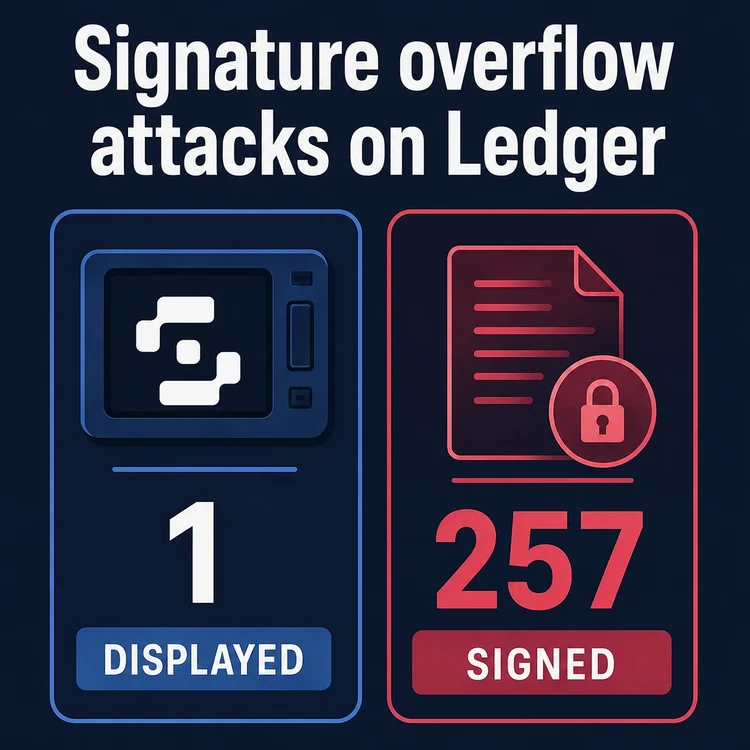
A Ledger Clear Signing parser bug let an affected device display one action while signing 257. We examine the Safe, Aave, and Morpho attack paths, practical exploitation, and the architectural implications.
Advanced security for decentralized systems: integrity, resilience, and trust.
ContactSafeguarding DeFi ecosystems by intercepting attacks in real time.
A Ledger Clear Signing parser bug let an affected device display one action while signing 257. We examine the Safe, Aave, and Morpho attack paths, practical exploitation, and the architectural implications.

On November 3rd, Bitfinding's Exploit Interception Agent secured over $975,000 from the Balancer exploit, deploying countermeasures in less than 12 seconds after the attacker's first move and preventing further losses in one of the year's most sophisticated DeFi attacks.

We're launching the Unblind Safe Dashboard, a simple utility to verify your pending Safe transactions. It uses Unblind API to translate cryptic data into plain English, ensuring you never have to sign blind again.

Crypto users face a constant threat: sophisticated phishing attacks and wallet drainers that trick them into signing away their assets. The core of this problem is the cryptic nature of signing requests, which even experienced users can misinterpret. To combat this, we built Unblind: an engine that explains any signing requests in plain English. This time we are releasing our Metamask Snap that delivers this human-readable summary via a secure, out-of-band Telegram message, arming you with the knowledge to approve or reject a transaction.

Transaction simulations can be misleading due to 'state divergence' - critical on-chain conditions changing post-simulation. This post explores how to enforce simulation integrity by embedding 'state constraints' within transactions, leveraging EIP-7702 and ERC-4337, to ensure your intended outcomes are what you actually get on-chain.

Trying to nail that perfect arbitrage, execute a complex multi-step DeFi strategy, or even simulate a frontrunning attack often means wrestling with multiple transactions, timing risks, and callback hell. We faced these challenges constantly while intercepting attacks at Bitfinding. That's why we created Multiplexer, our internal engine for crafting powerful, precise, atomic Ethereum operations. Today, we're proud to open source it for everyone.

In response to high-profile hacks exploiting blind signing, we introduced a semantic second-factor system using independent device verification and transaction emulation to enhance Web3 security and protect users from spoofed transactions on compromised devices.

On Saturday, January 18th, Bitfinding's Exploit Interception Agent deployed counter measures in just 3.2 seconds, detecting, halting, and intercepting an exploit targeting Paribus.io on Arbitrum.

We successfully rescued $54k on the Arbitrum network, frontrunning an attacker and securing vulnerable assets, validating our approach to real-time DeFi exploit prevention.


